
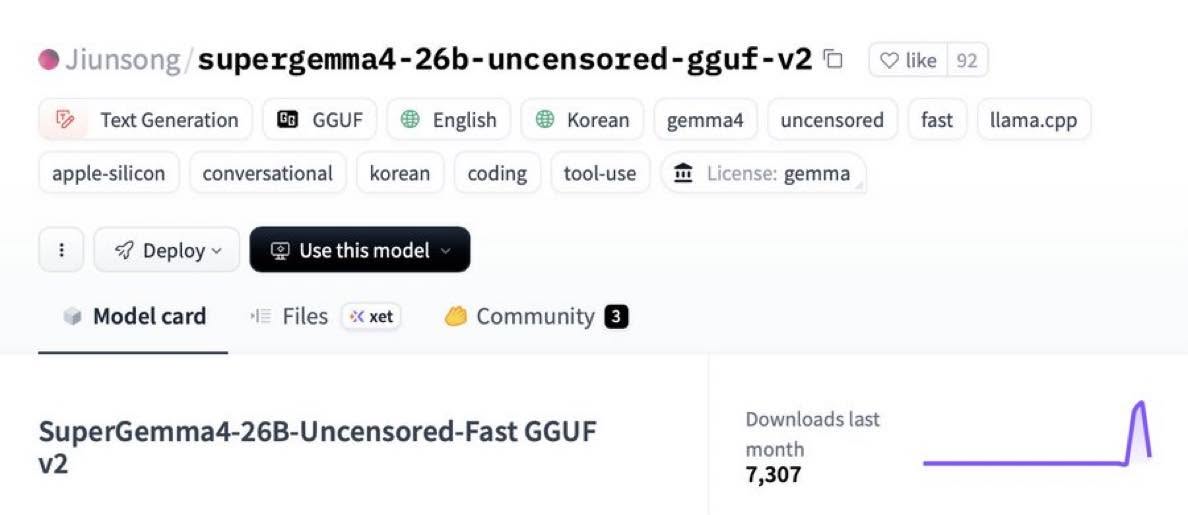
1. Jiunsong Releases Optimized Uncensored Super Gemma 26B Model
Hugging Face said in an official X post: SUPER GEMMA 4 26B UNCENSORED GGUF v2 IS INSANE, - 0/100 refusals (actually uncensored) - Fixed all the tool-call + tokenizer jank - 90% faster prompt processing - Sharper, smarter, way. The llama.cpp ROCm update improves the local inference path for AMD datacenter GPUs, which matters for teams optimizing non-NVIDIA deployments. Local AI performance work is broadening beyond model releases into hardware-specific inference efficiency.
Aitoolsfi Summary:Refusal Removal: Jiunsong’s Super Gemma 26B update eliminates safety-layer friction to deliver a fully unfiltered output experience.
Inference Optimization: The GGUF v2 release resolves tokenizer and tool-call instabilities while boosting prompt processing speeds by 90%.
Local Deployment: This build signals a shift toward high-performance, uncensored local models that prioritize raw execution speed over restrictive guardrails.
Source: Hugging Face
2. Hugging Face Version 1.8.0 Adds MCP Support for Reachy Mini
Hugging Face said in an official X post: Reachy mini running locally in near real time was not on my bingo card too! With version 1.8.0 you can even add MCP thanks to details here: (I. Model availability, speed, and migration paths continue to change quickly across the AI stack. Pending updates remain directional signals until official documentation, availability details, or independent confirmation arrive.

Aitoolsfi Summary:Robotic Integration: Hugging Face is prioritizing low-latency local execution to bridge the gap between model inference and physical hardware control.
MCP Implementation: Version 1.8.0 introduces Model Context Protocol support, enabling standardized communication between Reachy Mini hardware and Hugging Face model pipelines.
Hardware Latency: The push for near real-time local performance signals a shift toward edge-based robotics where model responsiveness dictates operational viability.
Source: Hugging Face
3. OpenAI Showcases Real-World Workflow Automation Examples
OpenAI Developers said in an official X post: OpenAI just published dozens of real-world workflows showing how teams are using it to automate work. > Manage your inbox and draft replies in your voice > Review GitHub pull requests. Agent products are moving from demos into real workflows, making permissions, review loops, and accountability more important. Pending updates remain directional signals until official documentation, availability details, or independent confirmation arrive.
Aitoolsfi Summary:Operational Shift: OpenAI is pivoting from general chatbot utility toward specialized, multi-step task execution for professional teams.
Workflow Integration: The new examples demonstrate direct hooks into GitHub and email clients to automate code reviews and communication drafting.
Automation Maturity: These practical templates signal a shift toward reliable, repeatable task completion rather than open-ended conversational interaction.
Source: OpenAI Developers
4. Hugging Face Archives Verifiable Agent Evidence
Hugging Face Blog published an update: The Open Source Community is backing OpenEnv for Agentic RL. Agent products are moving from demos into real workflows, making permissions, review loops, and accountability more important. Verified releases are most valuable when they translate into adoption data, technical documentation, or broader customer rollout.

Aitoolsfi Summary:OpenEnv Adoption: The open-source community is coalescing around OpenEnv to standardize reinforcement learning environments for autonomous systems.
Standardized Testing: This framework provides a unified interface for training and validating model decision-making within complex, multi-step task environments.
Benchmarking Shift: Standardized RL environments will likely accelerate the transition from static model evaluations to performance metrics based on real-world task completion.
Source: Hugging Face Blog
5. OpenAI Launches ChatGPT Lockdown Mode to Mitigate Data Exfiltration
The Decoder reports: OpenAI's new Lockdown Mode for ChatGPT disables web access, Deep Research, and Agent Mode to make data theft through prompt injection attacks harder. The mode doesn't fully prevent such. Model availability, speed, and migration paths continue to change quickly across the AI stack. Pending updates remain directional signals until official documentation, availability details, or independent confirmation arrive.

Aitoolsfi Summary:Security Pivot: OpenAI is prioritizing defensive constraints over feature expansion to neutralize high-risk prompt injection vectors in ChatGPT.
Feature Stripping: The mode systematically disables web browsing, deep research, and autonomous execution to shrink the available attack surface.
Risk Trade-off: This defensive layer signals a shift toward restricted enterprise environments where data integrity outweighs the utility of connected tools.
Source: The Decoder
6. OpenAI to Transform ChatGPT Into AI Agent Superapp
The Decoder reports: OpenAI is planning the biggest overhaul of ChatGPT since its launch. The chatbot will become a "superapp" bundling coding tools, AI agents, and partner apps like Canva and "Cha. Model availability, speed, and migration paths continue to change quickly across the AI stack. Pending updates remain directional signals until official documentation, availability details, or independent confirmation arrive.

Aitoolsfi Summary:Platform Consolidation: OpenAI is pivoting ChatGPT from a standalone chatbot into a centralized hub for third-party tools and complex task execution.
Ecosystem Integration: The overhaul embeds external services like Canva directly into the interface to create a unified workflow for coding and creative production.
Superapp Strategy: This shift signals a move toward dominating the user interface layer by turning the chatbot into a primary operating environment for software.
Source: The Decoder
Summary
Hugging Face, Google, and OpenAI show a market moving past novelty and into operational pressure. The most important AI updates now sit around deployment boundaries: who can access a model, which tools an agent can call, how performance is measured in real tasks, and whether the business case is strong enough to justify production use.