
Free
$0Free plan available.
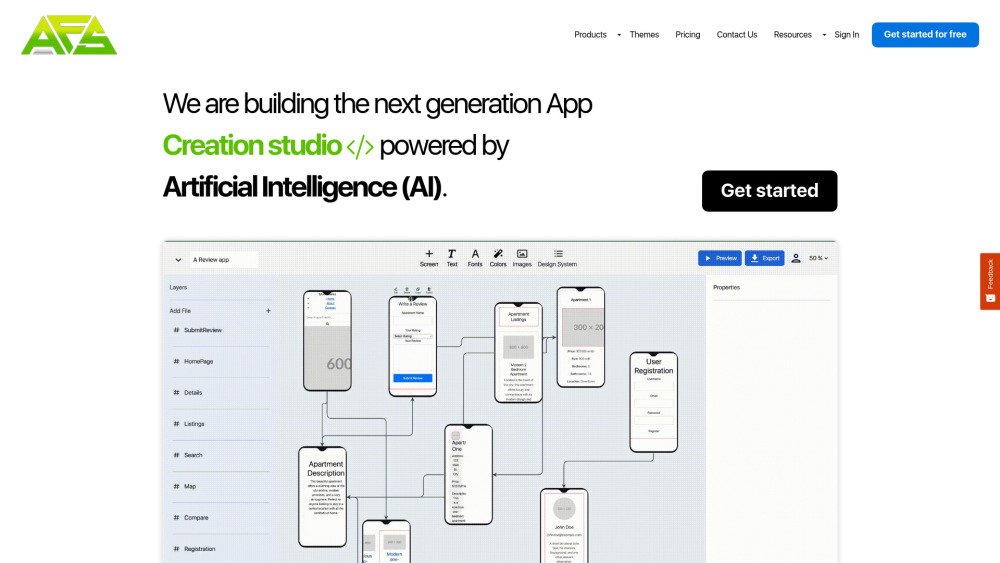
AppForceStudio is an AI-powered app creation platform that supports AI prompting, online code editing, storyboarding, prototyping, and design system creation. It streamlines the workflow from design to deployment with powerful AI tools for code generation and more.
Begin by signing up for a free account. Next, utilize the platform's AI-driven tools for code generation, prototyping, and visual storyboarding to bring your concepts to life. The platform also supports collaborative workflows for teams.
AppForceStudio is a comprehensive development platform built to streamline the creation, testing, and deployment of mobile and web applications. It includes features such as AI-driven code generation, drag-and-drop builders, pre-built templates, and visual design interfaces to simplify and accelerate the development process.
AppForceStudio is designed for developers, designers, project managers, startups, small businesses, educators, students, and freelancers who want to efficiently build, test, and launch mobile or web applications regardless of their coding expertise.
No coding expertise is required. AppForceStudio provides a user-friendly environment with drag-and-drop builders, visual development tools, and AI-powered assistance, making it accessible to users ranging from beginners to experienced developers.
AppForceStudio enables you to build various applications, including iOS and Android mobile apps, web applications, and cross-platform apps that function across both mobile and web environments.
AppForceStudio is intended to enhance the design process rather than replace human designers. While the platform provides tools to accelerate development, human creativity and expertise remain essential for producing high-quality, user-centric designs.
AppForceStudio prioritizes data security through measures such as encryption, access controls, and adherence to data protection regulations. Users are encouraged to review the platform's specific security policies to understand how their data is protected.
Free plan available.
Use these comparison pages to understand the trade-offs between the models most relevant to AppForceStudio.
Compare Gemini 1.0 Pro Deprecated and Gemini 2.0 Flash across pricing, context window, capabilities, benchmarks, and API access to choose the better fit for long-context workloads versus long-context workloads.
Compare Gemini 1.0 Pro Deprecated and Gemini 2.5 Flash across pricing, context window, capabilities, benchmarks, and API access to choose the better fit for long-context workloads versus long-context workloads.
Compare Gemini 2.0 Flash Lite and Gemini 2.0 Flash across pricing, context window, capabilities, benchmarks, and API access to choose the better fit for long-context workloads versus long-context workloads.
Compare Gemini 2.5 Flash and Gemini 2.0 Flash across pricing, context window, capabilities, benchmarks, and API access to choose the better fit for long-context workloads versus long-context workloads.

Similar AI tool in the AI Chatbot category.
Similar AI tool in the AI Marketing category.
Similar AI tool in the AI Chatbot category.
Similar AI tool in the AI Assistant category.
Similar AI tool in the AI Writing Assistants category.
Similar AI tool in the No-Code&Low-Code category.
Similar AI tool in the AI Chatbot category.
Similar AI tool in the AI Image Generator category.
Similar AI tool in the AI Image Generator category.
Similar AI tool in the AI Assistant category.
Similar AI tool in the AI Image Generator category.
Similar AI tool in the AI Chatbot category.