
Free
$0Free plan available.
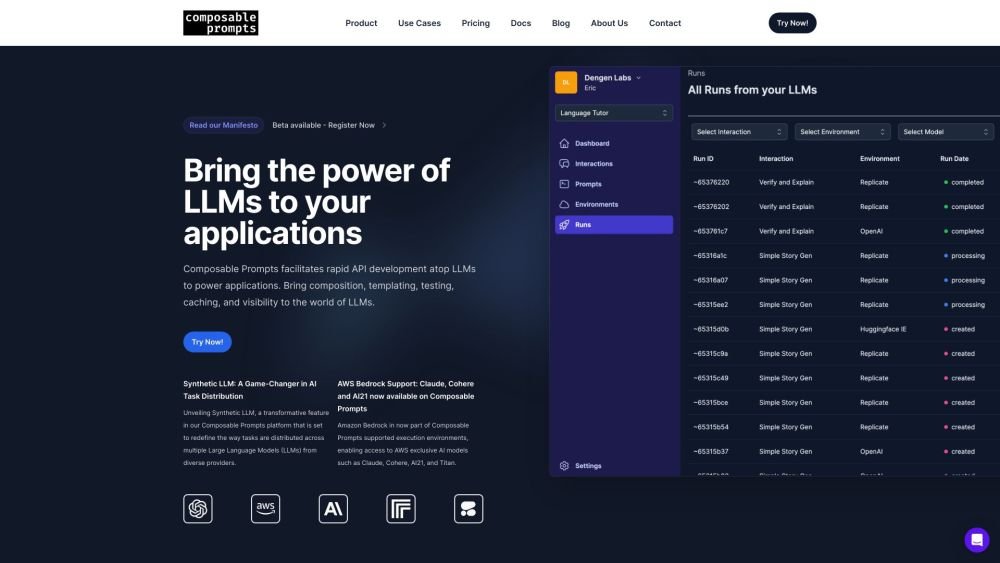
Vertesia is a low-code generative AI development platform that facilitates rapid API development atop LLMs to power applications. It provides enterprise-scale generative AI development solutions to develop, deploy, and operate low-code GenAI applications and agents at lightning pace. Vertesia offers composition, templating, testing, orchestration, caching, load-balancing, and visibility to the world of LLMs.
Use Vertesia's low-code platform to build generative AI apps and agents. Develop, deploy, and operate GenAI apps at enterprise scale. Automate complex business processes, optimize costs, and scale GenAI apps across your business.
Generative AI development solutions are software platforms that help organizations quickly design, test, and deploy custom generative AI agents and applications. Vertesia is a unified, low-code solution that accelerates development and testing while providing a full runtime operating environment.
Common use cases include automatic first notice of loss in insurance, M&A deal room analysis in investment banking, and customer onboarding in commercial banking. In logistics and manufacturing, companies use generative AI to process bills of lading and optimize supply chains.
It varies. For companies building their own infrastructure, it can take over six months. Vertesia customers typically develop, test, and deploy new generative AI applications in a few weeks.
Generative AI agents and apps are typically services that can be called from any existing workflow, process, or enterprise application. The Vertesia platform is API-first, meaning any task, prompt, or project built with Vertesia is automatically assigned a unique REST API endpoint for seamless integration.
For companies that build their own infrastructure or outsource development, costs can reach hundreds of thousands of dollars per solution. Vertesia customers can deploy new generative AI agents and apps more than 10x faster than with homegrown solutions and at less than 1/10th of the cost.
Generative AI development solutions are highly secure. Vertesia is SOC2 Type II-certified and supports data privacy standards such as HIPAA, GDPR, and CCPA. Vertesia is not a model provider and does not require access to your data.
Free plan available.
Use these comparison pages to understand the trade-offs between the models most relevant to Vertesia.
Compare Amazon Nova Pro and Amazon Nova Lite across pricing, context window, capabilities, benchmarks, and API access to choose the better fit for tool-augmented workflows versus tool-augmented workflows.
Compare Amazon Nova Lite and Amazon Nova Micro across pricing, context window, capabilities, benchmarks, and API access to choose the better fit for tool-augmented workflows versus tool-augmented workflows.
Compare Amazon Nova Lite and Mistral Medium 3 across pricing, context window, capabilities, benchmarks, and API access to choose the better fit for tool-augmented workflows versus tool-augmented workflows.
Compare Amazon Nova Lite and Mistral Small 3.1 (25.03) across pricing, context window, capabilities, benchmarks, and API access to choose the better fit for tool-augmented workflows versus cost-efficient scale.

Similar AI tool in the AI Chatbot category.
Similar AI tool in the AI Assistant category.
Similar AI tool in the AI Assistant category.
Similar AI tool in the AI Productivity Tools category.
Similar AI tool in the AI Assistant category.
Similar AI tool in the AI API category.
Similar AI tool in the AI Assistant category.
Similar AI tool in the AI Chatbot category.
Similar AI tool in the AI Productivity Tools category.
Similar AI tool in the AI Assistant category.
Similar AI tool in the AI Chatbot category.
Similar AI tool in the AI Assistant category.