
Free
$0Free plan available.
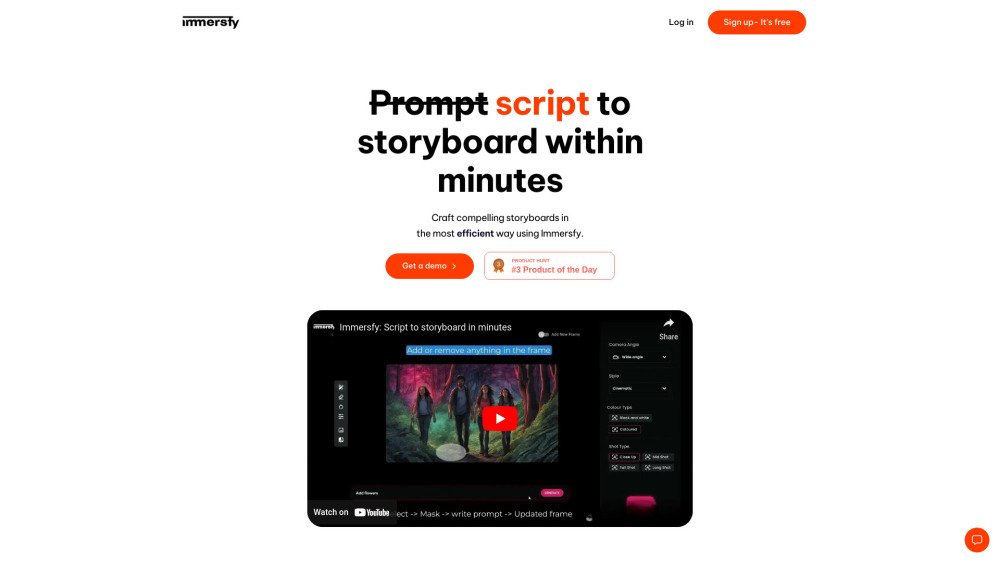
Immersfy is an AI-powered storyboarding tool that converts scripts into cinematic storyboards in minutes. By analyzing scripts and breaking down scenes, it creates visual representations that help users save 80% of their time and 50% of their costs. The platform includes robust customization features, ensuring users maintain full control over the tone, style, and context of their projects.
Users can upload scripts in various formats, including PDF, Final Draft, or plain text. Immersfy analyzes the content and automatically generates storyboard frames. Users can then refine these storyboards by editing scenes, adjusting compositions, modifying character poses, and fine-tuning details to align with their creative vision. The platform also supports real-time collaboration for team feedback and adjustments.
Immersfy utilizes advanced AI to analyze your script and automatically generate storyboard frames. The AI interprets scene context, character emotions, and cinematographic principles to produce visually compelling results.
Most storyboards are generated within minutes. Processing time varies based on the length and complexity of your script, though the AI is designed to maintain quality and consistency throughout.
Yes, you have full control over the output. You can edit scenes, adjust compositions, modify character poses, and fine-tune every element to match your creative vision.
We support major script formats, including PDF, Final Draft (.fdx), and plain text. Exported storyboards can be saved as PNG, JPG, PDF, or our native collaborative project format.
Yes, our platform includes real-time collaboration tools that allow multiple team members to work on the same storyboard, leave comments, and track changes to streamline production.
Free plan available.
Use these comparison pages to understand the trade-offs between the models most relevant to Immersfy.
Compare Gemini 1.0 Pro Deprecated and Gemini 2.0 Flash across pricing, context window, capabilities, benchmarks, and API access to choose the better fit for long-context workloads versus long-context workloads.
Compare Gemini 1.0 Pro Deprecated and Gemini 2.5 Flash across pricing, context window, capabilities, benchmarks, and API access to choose the better fit for long-context workloads versus long-context workloads.
Compare Gemini 2.0 Flash Lite and Gemini 2.0 Flash across pricing, context window, capabilities, benchmarks, and API access to choose the better fit for long-context workloads versus long-context workloads.
Compare Gemini 2.5 Flash and Gemini 2.0 Flash across pricing, context window, capabilities, benchmarks, and API access to choose the better fit for long-context workloads versus long-context workloads.

Similar AI tool in the AI Image Generator category.
Similar AI tool in the AI Chatbot category.
Similar AI tool in the AI Video Generator category.
Similar AI tool in the AI Image Generator category.
Similar AI tool in the AI Image Generator category.
Similar AI tool in the AI Assistant category.
Similar AI tool in the AI Video Generator category.
Similar AI tool in the AI Image Generator category.
Similar AI tool in the AI Art Generator category.
Similar AI tool in the AI Image Generator category.
Similar AI tool in the AI Assistant category.
Similar AI tool in the AI Image Generator category.