
Free
$0Free plan available.
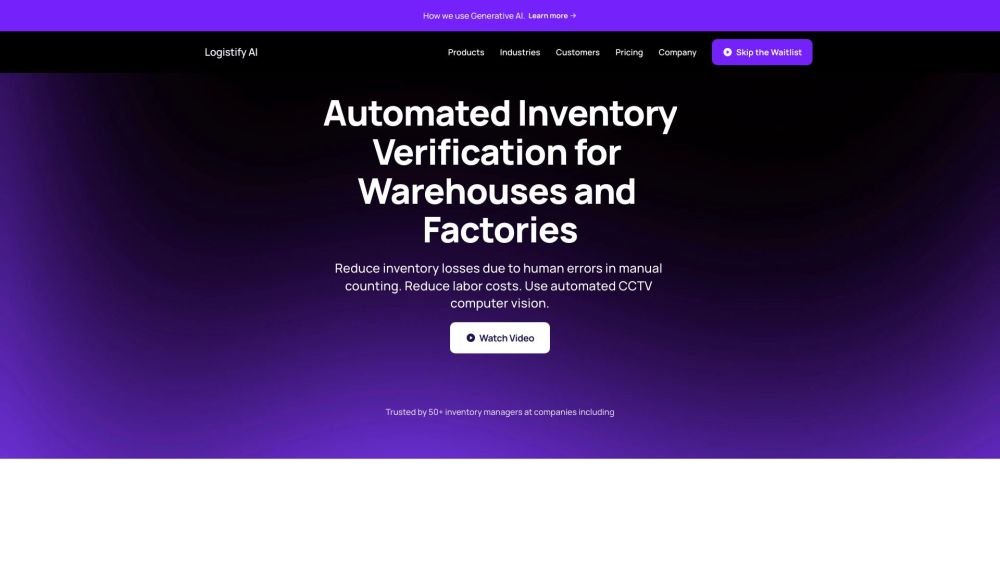
Logistify AI is an AI assistant for supply chain managers. It provides generative AI-powered agents that automate sales, procurement, and inventory workflows, eliminating the need for unnecessary fixed, long-term leases and deposit fees. The platform automates the entire lead-to-cash cycle for distributors and commodity traders, covering everything from lead generation to payment and debt collection. It also automates the entry of sales orders or procurement bills from various sources into ERP systems, which reduces data entry errors and allows teams to focus on more critical work.
Logistify AI integrates with your existing ERP, IMS, or WMS systems. Users can deploy AI agents to automate specific workflows, including sales lead generation, sales order entry, procurement, inventory verification, and demand forecasting. The platform's pricing is based on the volume of tasks successfully completed by the agents.
Logistify AI is an AI assistant for logistics and supply chain managers, functioning similarly to ChatGPT but specifically tailored for supply chain management.
The AI assistant automates various supply chain management workflows, including sales, procurement, and inventory tasks.
No, Logistify AI integrates with your current ERP system to automate your existing workflows.
Logistify AI charges a flat monthly fee based on the volume of tasks successfully completed by the agents, rather than charging per user.
This information is not currently available and requires further clarification.
This information is not currently available and requires further clarification.
This information is not currently available and requires further clarification.
Free plan available.
Use these comparison pages to understand the trade-offs between the models most relevant to Logistify AI.
Compare GPT 5.4 and GPT 5.4 Pro across pricing, context window, capabilities, benchmarks, and API access to choose the better fit for long-context workloads versus long-context workloads.
Compare GPT 5.5 and GPT 5.4 across pricing, context window, capabilities, benchmarks, and API access to choose the better fit for long-context workloads versus long-context workloads.
Compare GPT 5.5 and Claude 4.6 Opus across pricing, context window, capabilities, benchmarks, and API access to choose the better fit for long-context workloads versus long-context workloads.
Compare GPT 5.5 and Claude 4.6 Sonnet across pricing, context window, capabilities, benchmarks, and API access to choose the better fit for long-context workloads versus long-context workloads.

Similar AI tool in the AI Chatbot category.
Similar AI tool in the AI Assistant category.
Similar AI tool in the AI Assistant category.
Similar AI tool in the AI Marketing category.
Similar AI tool in the AI Assistant category.
Similar AI tool in the AI API category.
Similar AI tool in the AI Assistant category.
Similar AI tool in the AI Assistant category.
Similar AI tool in the AI Chatbot category.
Similar AI tool in the No-Code&Low-Code category.
Similar AI tool in the AI Productivity Tools category.
Similar AI tool in the AI Marketing category.