
Free
$0Free plan available.
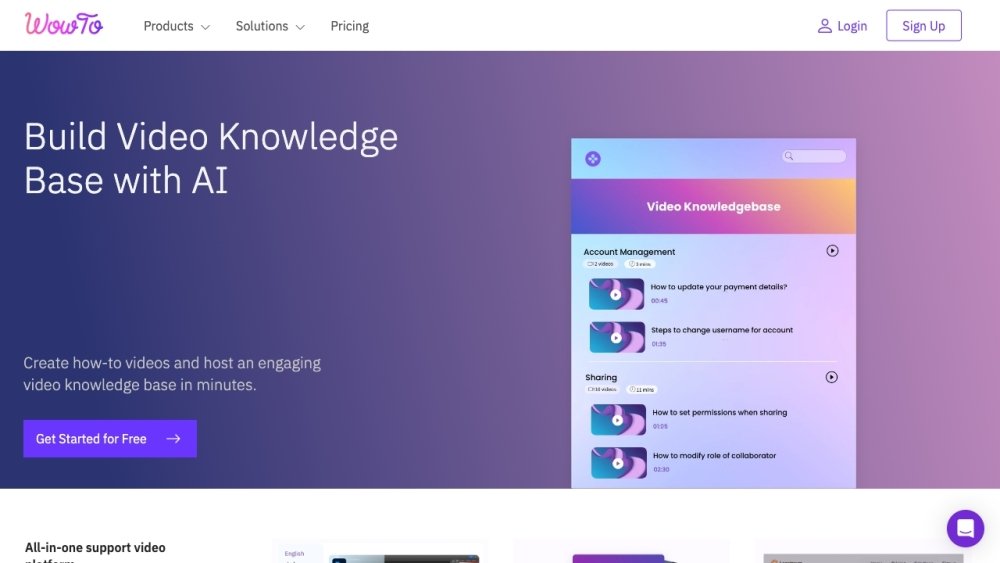
WowTo is a platform designed to create how-to videos and host engaging video knowledge bases. It offers tools to build video knowledge bases, create support videos with AI, and convert existing training presentations into engaging training videos. WowTo also provides features like AI voiceovers, AI avatars, and a video editor with blurring, highlighting, and annotation capabilities.
Use WowTo to create support, training, and educational videos. Capture workflows using the Chrome extension, import screen recordings, convert PPT or PDF files into video, add AI voiceovers and avatars, and publish a branded video knowledge base.
A video project consists of one how-to video generated in multiple languages, depending on your plan. Each video can be downloaded as an MP4 file or shared collectively via the WowTo video player.
A video knowledge base is a library of product tutorials or how-to videos hosted on your website. It serves as a central resource for users to find answers to their product-related questions.
The WowTo in-app video widget is an embeddable tool for your website or application that displays relevant content to guide users through their product journey. You can configure videos to appear based on specific user actions.
Yes, the free plan is free forever. It allows you to create 15 videos, each with a maximum duration of 2 minutes, and includes a WowTo watermark. You can host a video knowledge base with these 15 videos, which will include a 'Powered by WowTo' badge.
To upgrade, log in to your WowTo account and select the 'Upgrade' button located in the top toolbar of the application.
Yes, you may cancel your subscription at any time before the next billing cycle to prevent future charges. Refunds are not provided for active subscriptions.
Yes, you can download your videos at any time for use elsewhere without needing additional permissions. Note that videos created on the free plan will include a WowTo watermark in the bottom right corner.
Free plan available.
Use these comparison pages to understand the trade-offs between the models most relevant to WowTo.
Compare Gemini 1.0 Pro Deprecated and Gemini 2.0 Flash across pricing, context window, capabilities, benchmarks, and API access to choose the better fit for long-context workloads versus long-context workloads.
Compare Gemini 1.0 Pro Deprecated and Gemini 2.5 Flash across pricing, context window, capabilities, benchmarks, and API access to choose the better fit for long-context workloads versus long-context workloads.
Compare Gemini 2.0 Flash Lite and Gemini 2.0 Flash across pricing, context window, capabilities, benchmarks, and API access to choose the better fit for long-context workloads versus long-context workloads.
Compare Gemini 2.5 Flash and Gemini 2.0 Flash across pricing, context window, capabilities, benchmarks, and API access to choose the better fit for long-context workloads versus long-context workloads.

Similar AI tool in the AI Chatbot category.
Similar AI tool in the AI Assistant category.
Similar AI tool in the AI Chatbot category.
Similar AI tool in the AI Marketing category.
Similar AI tool in the AI Image Generator category.
Similar AI tool in the AI Chatbot category.
Similar AI tool in the AI Image Generator category.
Similar AI tool in the AI Video Generator category.
Similar AI tool in the AI Image Generator category.
Similar AI tool in the AI Writing Assistants category.
Similar AI tool in the AI Video Generator category.
Similar AI tool in the AI Chatbot category.