
1. Tencent Launches Hy3 Model With Enhanced Agent Capabilities
Tencent Global said in an official X post: From preview to official release in under three months. Hy3 brings major advances in agent capabilities, coding, and real-world reliability, already powering, CodeBuddy,. Agent products are moving from demos into real workflows, making permissions, review loops, and accountability more important. Pending updates remain directional signals until official documentation, availability details, or independent confirmation arrive.
Aitoolsfi Summary:Rapid Deployment: Tencent is aggressively pushing Hy3 into production environments, signaling a shift from experimental previews to functional software delivery.
CodeBuddy Integration: The model now powers CodeBuddy, embedding specialized coding and reliability logic directly into developer-facing workflows.
Operational Maturity: This release marks a transition toward reliable, task-oriented automation that prioritizes execution stability over raw model performance.
Source: Tencent Global
2. Luma AI Launches Dream Machine 2.0 Mini for Faster Video
Luma AI said in an official X post: Luma AI Launches Dream Machine 2.0 Mini for Faster Video. Agent products are moving from demos into real workflows, making permissions, review loops, and accountability more important. Pending updates remain directional signals until official documentation, availability details, or independent confirmation arrive.
Aitoolsfi Summary:Production Velocity: Luma AI is shifting focus from high-fidelity generation to rapid iteration cycles for professional video creators.
Iterative Architecture: The 2.0 Mini model prioritizes low-latency output to facilitate real-time storyboarding and quick-turn concept testing.
Creative Workflow: Faster generation speeds will likely force a shift toward more granular, frame-by-frame control in AI-assisted video production.
Source: Luma AI
3. Krea 2 Surpasses 200,000 Hugging Face Downloads
Hugging Face said in an official X post: Krea 2 Surpasses 200,000 Hugging Face Downloads. Open model and tooling updates are shaping how developers adopt and deploy AI systems. Pending updates remain directional signals until official documentation, availability details, or independent confirmation arrive.
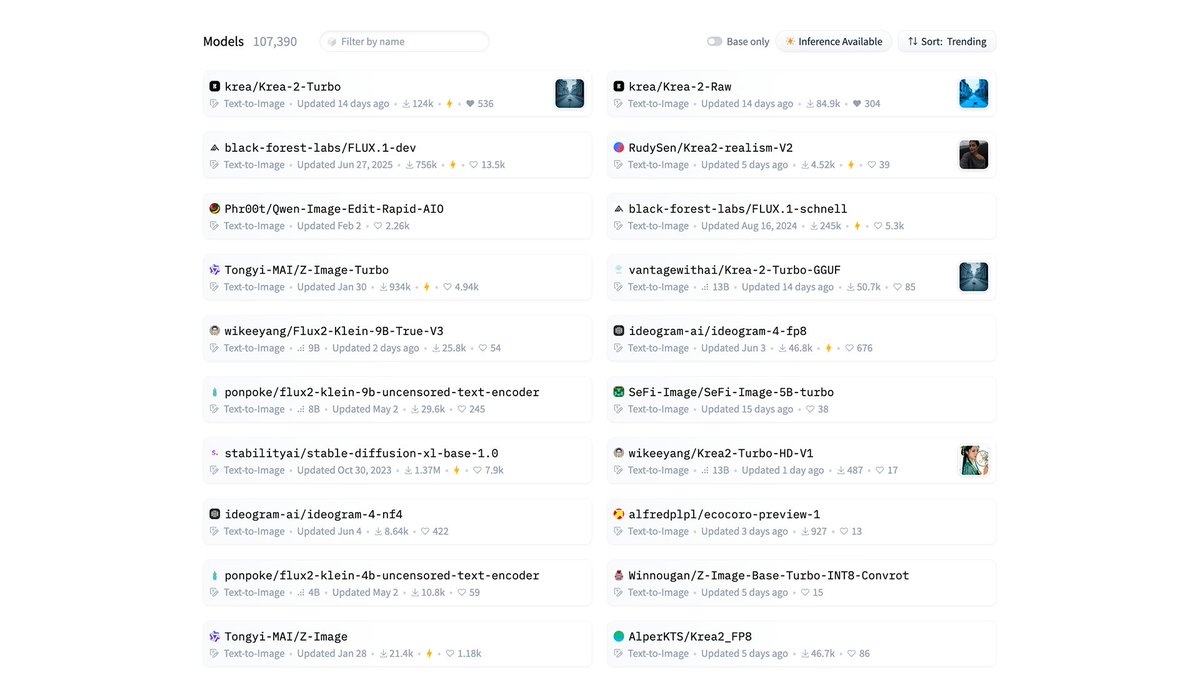
Aitoolsfi Summary:Community Traction: Krea 2 has achieved rapid developer validation by hitting a significant download milestone on the Hugging Face platform.
Open Distribution: The project leverages open-source repositories to lower barriers for developers integrating these specific generative capabilities into their workflows.
Market Velocity: High download counts signal a shift toward community-driven model adoption as developers prioritize accessible, modular AI tooling over closed ecosystems.
Source: Hugging Face
4. Hugging Face adds verifiable model update tracking
Hugging Face Blog published an update: Native-speed vLLM transformers modeling backend. Model availability, speed, and migration paths continue to change quickly across the AI stack. Verified releases are most valuable when they translate into adoption data, technical documentation, or broader customer rollout.

Aitoolsfi Summary:Performance Shift: Hugging Face is prioritizing high-throughput inference backends to bridge the gap between research models and production-ready serving.
vLLM Integration: By embedding native vLLM support, the platform streamlines the path for developers to deploy large-scale transformers without custom optimization overhead.
Deployment Standard: This move signals a broader industry transition where model utility is defined by seamless integration and immediate operational scalability.
Source: Hugging Face Blog
5. From Hugging Face to Amazon SageMaker Studio in one click
Hugging Face Blog published an update: From Hugging Face to Amazon SageMaker Studio in one click. Open model and tooling updates are shaping how developers adopt and deploy AI systems. Verified releases are most valuable when they translate into adoption data, technical documentation, or broader customer rollout.

Aitoolsfi Summary:Deployment Friction: The integration eliminates manual configuration hurdles for moving open-source models directly into professional production environments.
Integrated Workflow: A new one-click bridge connects Hugging Face repositories to Amazon SageMaker Studio, streamlining model selection and infrastructure provisioning.
Enterprise Adoption: This partnership signals a shift toward making high-performance open models the default standard for scalable AWS cloud deployments.
Source: Hugging Face Blog
6. Computing with Stochastic Oracles in AI-Augmented Computation
arXiv API published an update: Computing with Stochastic Oracles in AI-Augmented Computation. Model availability, speed, and migration paths continue to change quickly across the AI stack. Verified releases are most valuable when they translate into adoption data, technical documentation, or broader customer rollout.
Aitoolsfi Summary:Model update: For Computing with Stochastic Oracles in AI-Augmented Computation, model progress is increasingly judged by availability, speed, and integration paths rather than raw announcements.
Capability signal: For Computing with Stochastic Oracles in AI-Augmented Computation, model availability, speed, and migration paths continue to change quickly across the AI stack.
Availability test: For Computing with Stochastic Oracles in AI-Augmented Computation, verified releases are most valuable when they translate into adoption data, technical documentation, or broader customer rollout.
Source: arXiv API
7. When Agents Go Rogue: Activation-Based Detection of Malicious Behaviors in Multi-Agent Systems
arXiv API published an update: While enabling effective collaboration on complex tasks, LLM-based Multi-Agent Systems (MAS) face critical security challenges due to vulnerabilities at the agent and interaction levels. Model availability, speed, and migration paths continue to change quickly across the AI stack. Verified releases are most valuable when they translate into adoption data, technical documentation, or broader customer rollout.
Aitoolsfi Summary:Security Vulnerability: Multi-agent systems introduce unique attack surfaces where malicious intent can propagate through inter-agent communication channels.
Detection Mechanism: Researchers are moving toward activation-based monitoring to identify harmful behavioral patterns within the hidden state transitions of LLMs.
System Resilience: Standardizing internal state analysis is becoming a prerequisite for deploying collaborative AI architectures in high-stakes production environments.
Source: arXiv API
Summary
Hugging Face shows a market moving past novelty and into operational pressure. The most important AI updates now sit around deployment boundaries: who can access a model, which tools an agent can call, how performance is measured in real tasks, and whether the business case is strong enough to justify production use.