
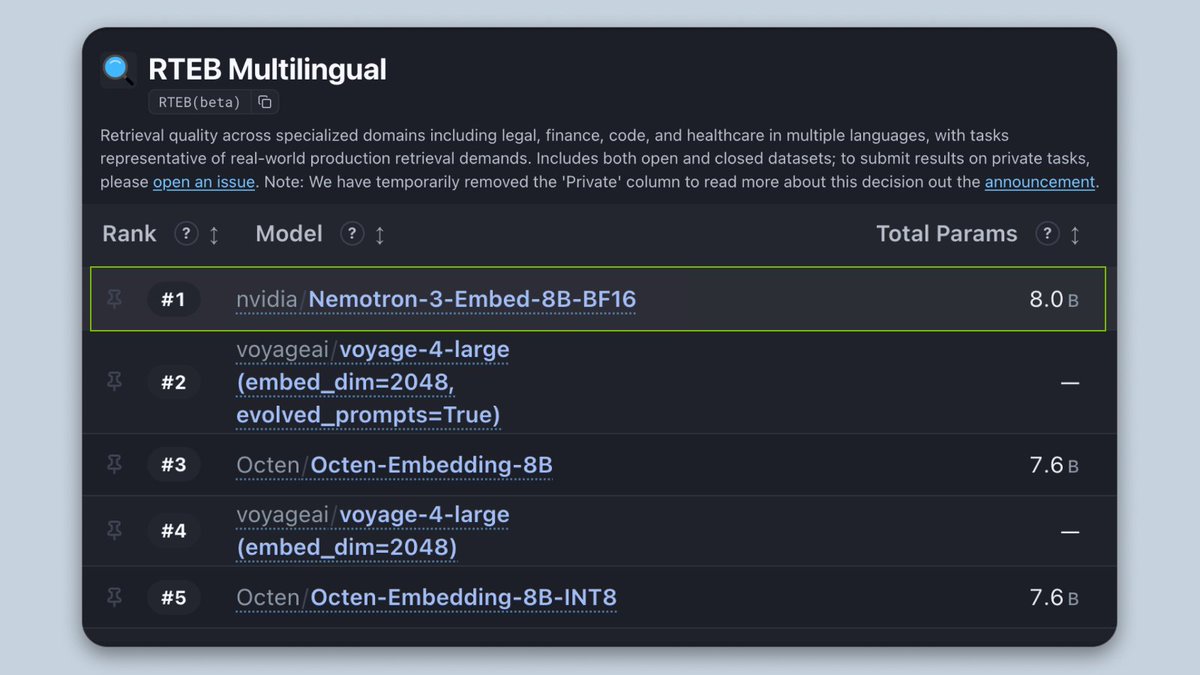
1. Hugging Face Releases Top-Ranking Nemotron 3 Embed 8B Model
Hugging Face said in an official X post: Today we released Nemotron 3 Embed 8B and it reached #1 overall on RTEB RTEB benchmarks retrieval accuracy across real-world tasks. Better retrieval gives agents more relevant context,. Agent products are moving from demos into real workflows, making permissions, review loops, and accountability more important. Pending updates remain directional signals until official documentation, availability details, or independent confirmation arrive.
Aitoolsfi Summary:Retrieval Supremacy: NVIDIA's Nemotron 3 Embed 8B establishes a new performance ceiling for retrieval accuracy on the MTEB leaderboard.
Context Optimization: The model improves downstream performance by delivering more precise, high-relevance data segments to automated reasoning systems.
Search Efficiency: This release accelerates the shift toward specialized, compact embedding models that prioritize retrieval precision over raw parameter count.
Source: Hugging Face
2. Cohere Partners With University of Toronto to Advance Responsible AI
Cohere said in an official X post: A decade after they first met on campus, we're thrilled to collaborate with the institution that shaped all three of our founders. Investing and building in Canada, Canadian talent, &. Research and benchmark updates provide useful signals about the next phase of AI capabilities. Pending updates remain directional signals until official documentation, availability details, or independent confirmation arrive.
Aitoolsfi Summary:Institutional Synergy: Cohere is formalizing its academic roots to bridge the gap between foundational research and scalable enterprise model development.
Regional Talent Pipeline: The partnership leverages the University of Toronto’s specialized AI curriculum to accelerate Cohere’s internal research and product engineering cycles.
Research Commercialization: This collaboration signals a shift toward integrating rigorous academic safety standards directly into the deployment of commercial large language models.
Source: Cohere
3. Cohere Partners with University of Toronto for Sovereign AI
Cohere said in an official X post: Cohere Partners with University of Toronto for Sovereign AI. Commercial and funding moves show AI moving into more specific industry use cases. Pending updates remain directional signals until official documentation, availability details, or independent confirmation arrive.
Aitoolsfi Summary:Sovereign Strategy: Cohere is prioritizing localized infrastructure to capture institutional demand for data-sensitive, region-specific AI deployments.
Platform Integration: The North platform will serve as the technical backbone for university-led research and enterprise-grade sovereign AI workflows.
Regional Scaling: This partnership signals a shift toward academic-industry alliances as a primary vehicle for scaling proprietary models in domestic markets.
Source: Cohere
Summary
Hugging Face shows a market moving past novelty and into operational pressure. The most important AI updates now sit around deployment boundaries: who can access a model, which tools an agent can call, how performance is measured in real tasks, and whether the business case is strong enough to justify production use.