
1. OpenAI Launches ChatGPT Work for Automated Workflow Execution
OpenAI said in an official X post: OpenAI Launches ChatGPT Work for Automated Workflow Execution. Model availability, speed, and migration paths continue to change quickly across the AI stack. Verified releases are most valuable when they translate into adoption data, technical documentation, or broader customer rollout.
Aitoolsfi Summary:Operational Pivot: OpenAI is shifting its flagship product from a conversational interface to a functional engine for executing multi-step business tasks.
Cross-Platform Integration: The new workflow architecture enables ChatGPT to bridge data and actions across desktop, mobile, and web environments seamlessly.
Productivity Shift: This transition signals a broader industry move toward AI tools that prioritize autonomous task completion over simple information retrieval.
Source: OpenAI
2. OpenAI Launches ChatGPT Work for Enterprise and Pro Plans
OpenAI said in an official X post: On web and mobile, ChatGPT Work is rolling out today for Pro, Enterprise, and Edu plans. It will roll out to Plus and Business plans over the next few days. In the ChatGPT desktop app,. Model availability, speed, and migration paths continue to change quickly across the AI stack. Pending updates remain directional signals until official documentation, availability details, or independent confirmation arrive.
Aitoolsfi Summary:Deployment Strategy: OpenAI is prioritizing high-tier organizational accounts to stabilize the rollout of its new ChatGPT Work interface.
Platform Integration: The update synchronizes feature parity across web, mobile, and desktop clients to unify the user experience for professional subscribers.
Market Scaling: Phased releases across subscription tiers signal a shift toward aggressive feature saturation within the existing paid user base.
Source: OpenAI
3. OpenAI GPT-5.6 Sol Sets New ARC-AGI Benchmark Records
OpenAI Developers said in an official X post: While scores at the top of ARC-AGI v1/2 are topping out at 95% there is still a lot the benchmark tell us about efficiency Not only does GPT-5.6 Sol get 92.5% on ARC-AGI-2 (sota) but it. Model availability, speed, and migration paths continue to change quickly across the AI stack. Pending updates remain directional signals until official documentation, availability details, or independent confirmation arrive.
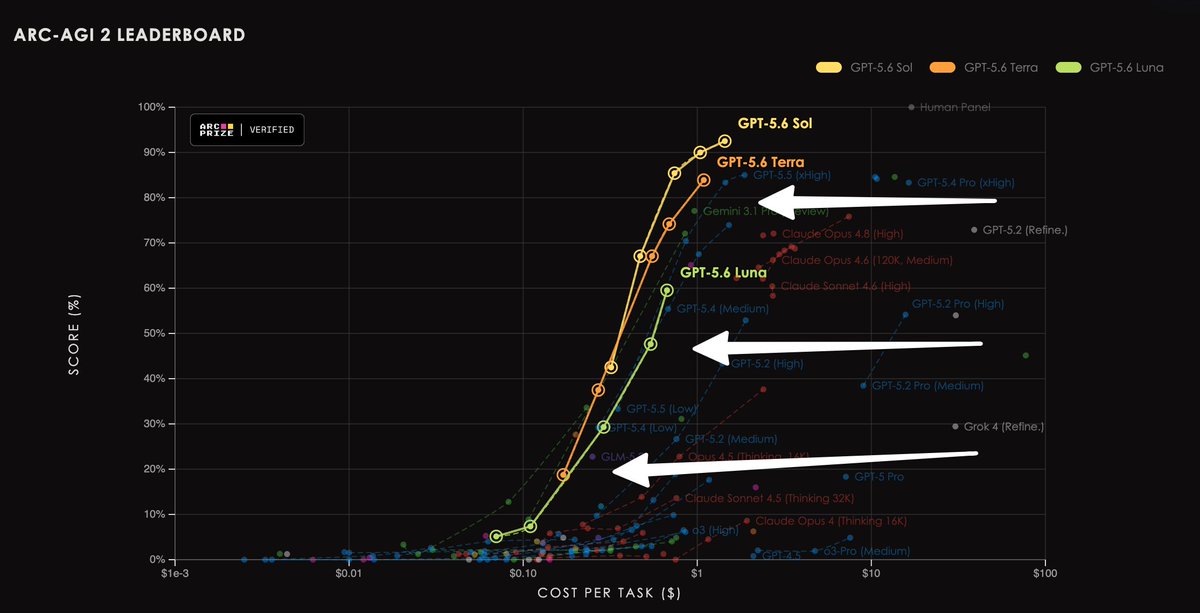
Aitoolsfi Summary:Benchmark Saturation: OpenAI’s GPT-5.6 Sol performance signals that ARC-AGI benchmarks are nearing a ceiling where raw accuracy matters less than operational efficiency.
Performance Metrics: The model achieves a state-of-the-art 92.5% on ARC-AGI-2, shifting the focus toward how these high-scoring models integrate into production workflows.
Verification Gap: These preliminary results remain directional indicators until OpenAI provides concrete documentation and public access to validate the model's actual utility.
Source: OpenAI Developers
4. Meta: Muse Spark is a multimodal reasoning model built for agentic ta
Meta AI said in an official X post: Meta: Muse Spark is a multimodal reasoning model built for agentic ta. Meta's subscription rollout shows major consumer platforms testing how AI features can fit into paid bundles for creators, businesses, and everyday users. AI is becoming a packaging lever inside broader social, creator, and business subscriptions rather than only a standalone product.
Aitoolsfi Summary:Reasoning Shift: Meta is pivoting its model architecture toward autonomous task execution to capture more complex workflow demands.
API Integration: The Muse Spark model is now accessible via Meta’s API, allowing developers to embed multimodal reasoning directly into third-party applications.
Developer Ecosystem: This release signals Meta's intent to dominate the agentic infrastructure market by providing specialized tooling for high-level coding and automation tasks.
Source: Meta AI
5. Google: Co-developed with @GoogleDeepMind, AlphaEvolve is a Gemini-powe
Google DeepMind said in an official X post: Google: Co-developed with @GoogleDeepMind, AlphaEvolve is a Gemini-powe. Model availability, speed, and migration paths continue to change quickly across the AI stack. Pending updates remain directional signals until official documentation, availability details, or independent confirmation arrive.
Aitoolsfi Summary:Automated Optimization: AlphaEvolve shifts the focus from manual coding to autonomous discovery of high-performance software architectures.
Gemini Integration: The system leverages Gemini’s reasoning capabilities to iterate on codebases directly within the Google Cloud ecosystem.
Development Velocity: This deployment signals a move toward self-improving infrastructure that could drastically shorten software development lifecycles.
Source: Google DeepMind
6. How did the government decide OpenAI’s frontier model was safe to release?
TechCrunch reports: "Exactly what that dialog looked like between the government and Anthropic and OpenAI is unclear.". Model availability, speed, and migration paths continue to change quickly across the AI stack. Pending updates remain directional signals until official documentation, availability details, or independent confirmation arrive.

Aitoolsfi Summary:Opaque Oversight: Regulatory vetting processes for frontier model releases remain shielded from public scrutiny despite growing industry influence.
Communication Gap: The lack of transparency regarding government-led safety evaluations obscures how major labs like OpenAI secure deployment clearance.
Standardization Pressure: The absence of clear assessment protocols forces the industry to rely on informal signals rather than verifiable safety benchmarks.
Source: TechCrunch
7. OpenAI Launches ChatGPT Work With Cloud and Local Limitations
Simon Willison reports: [.] Work on web and mobile runs in the cloud. Work in the desktop app can also use local files and desktop apps with your permission. At launch, cloud Work conversations do not appear. Model availability, speed, and migration paths continue to change quickly across the AI stack. Pending updates remain directional signals until official documentation, availability details, or independent confirmation arrive.
Aitoolsfi Summary:Fragmented Architecture: OpenAI is bifurcating the ChatGPT experience by separating cloud-based web sessions from local, file-aware desktop processing.
Desktop Integration: The desktop application functions as a distinct environment capable of accessing local files and system-level data that remain invisible to web interfaces.
Workflow Silos: This architectural split forces users to manage separate interaction contexts, complicating unified workflows across mobile and desktop platforms.
Source: Simon Willison
8. OpenAI Launches ChatGPT Work Agent Powered by GPT-5.6
The Decoder reports: OpenAI Launches ChatGPT Work Agent Powered by GPT-5.6. Model availability, speed, and migration paths continue to change quickly across the AI stack. Pending updates remain directional signals until official documentation, availability details, or independent confirmation arrive.

Aitoolsfi Summary:Model update: For OpenAI Launches ChatGPT Work Agent Powered by GPT-5.6, model progress is increasingly judged by availability, speed, and integration paths rather than raw announcements.
Capability signal: For OpenAI Launches ChatGPT Work Agent Powered by GPT-5.6, model availability, speed, and migration paths continue to change quickly across the AI stack.
Availability test: For OpenAI Launches ChatGPT Work Agent Powered by GPT-5.6, pending updates remain directional signals until official documentation, availability details, or independent confirmation arrive.
Source: The Decoder
Summary
OpenAI, Meta, and Google show a market moving past novelty and into operational pressure. The most important AI updates now sit around deployment boundaries: who can access a model, which tools an agent can call, how performance is measured in real tasks, and whether the business case is strong enough to justify production use.