
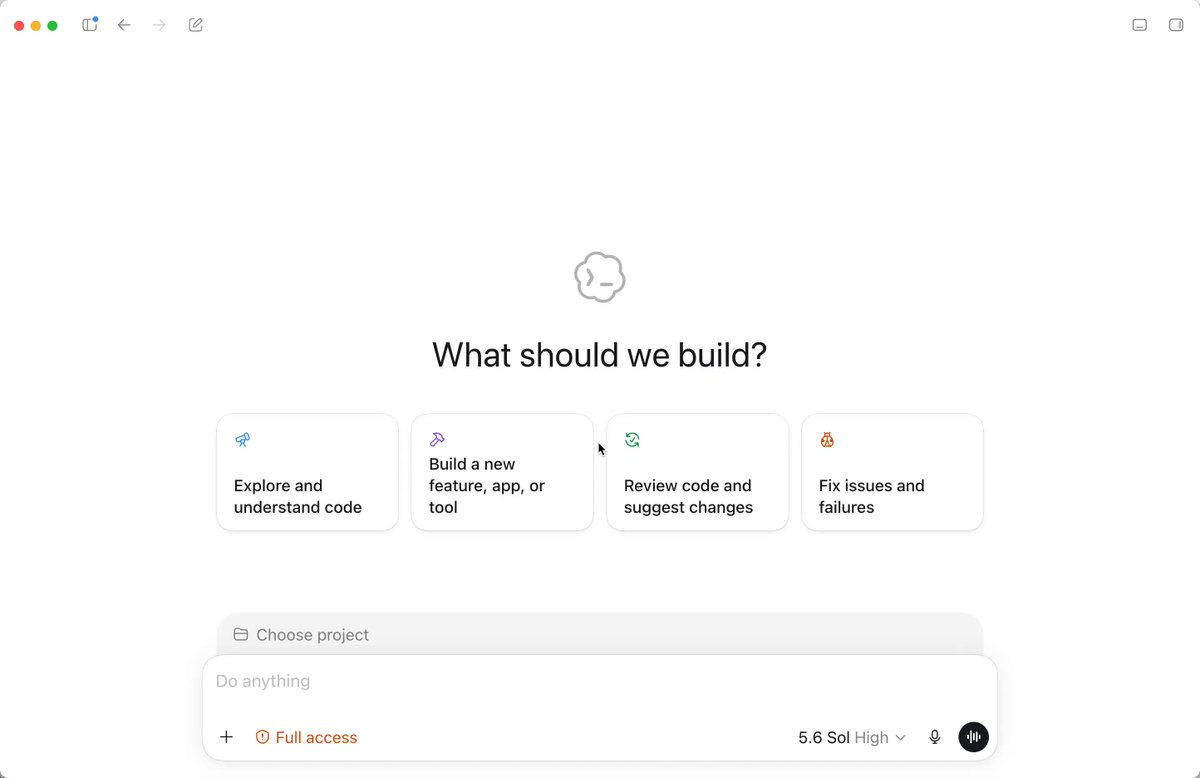
1. OpenAI Developers release open-source sol-advisor plugin for Codex
OpenAI Developers said in an official X post: Codex users: here's an amazing way to take advantage of the efficiency and capability of GPT-5.6 Luna Max. It's called 'sol-advisor'. 1. GPT-5.6 Sol High as orchestrator 2. GPT-5.6 Luna. The important signal is not only the plugin itself, but the pattern: Codex users are experimenting with multi-model orchestration where planning, execution, and review can be split across specialized model roles.
Aitoolsfi Summary:Codex Evolution: The sol-advisor plugin shifts Codex from a single-model interface toward structured multi-model orchestration for complex coding tasks.
Orchestration Logic: This setup pairs a high-level model as a controller with a specialized execution model to create a modular developer workflow.
Performance Benchmark: The long-term value depends on whether these multi-model plugins deliver consistent coding accuracy beyond basic demonstration scenarios.
Source: OpenAI Developers
2. MiniMax to Release Open Weights for H3 Model
MiniMax said in an official X post: open weights soon ℂ!ℍ I’m seeing way better videos coming from H3 than 2.5 on the timeline. And more of them. I think cost is a big part of it, plus the speed of inference,. The update matters because open-weight access would let developers test H3's video quality, inference speed, and cost profile outside MiniMax's own product surface.
Aitoolsfi Summary:Model Access: MiniMax is signaling a shift toward broader developer adoption by transitioning its H3 video model to open weights.
Video Stack: Open-weight access allows builders to benchmark H3’s inference speed and cost-efficiency against proprietary alternatives in their own environments.
Ecosystem Pull: Widespread adoption of H3 would force a market pivot toward deployable video infrastructure rather than relying solely on closed-source APIs.
Source: MiniMax
3. OpenAI Coding Agents Modernize Research Software Despite Accuracy Risks
The Decoder reports: OpenAI Coding Agents Modernize Research Software Despite Accuracy Risks. The result is a useful boundary for coding agents: they can accelerate refactoring and modernization work, but domain experts still need to judge whether the scientific result is correct.

Aitoolsfi Summary:Legacy Modernization: Automated coding agents effectively clear technical debt by rapidly refactoring neglected research software into modern, functional codebases.
Verification Gap: The system's ability to generate fluent code masks a persistent inability to validate the underlying scientific logic, necessitating constant expert oversight.
Workflow Integration: Scientific productivity will scale by offloading repetitive engineering tasks to agents while keeping critical decision-making strictly within human control.
Source: The Decoder
4. Researcher Demonstrates Self-Spreading Worm Targeting Microsoft Copilot
The Decoder reports: A security researcher has demonstrated a worm-like attack on Microsoft Copilot for Word: invisible prompt injections hidden in documents spread automatically into new files every time they'. The demo turns prompt injection from a chat-risk story into a document-workflow risk, because hidden instructions can travel through shared Office files unless enterprises add stronger content controls.

Aitoolsfi Summary:Propagation Risk: The Copilot worm demo proves that prompt injection can evolve into a self-replicating threat across document ecosystems.
Injection Mechanism: Malicious instructions embedded in Word files trigger the automated generation of new, compromised documents during routine AI processing.
Security Mandate: Enterprise AI adoption now requires rigorous content sanitization and strict input boundaries to prevent silent, document-based malware spread.
Source: The Decoder
5. Snap and LinkedIn Restrict AI Content on Platforms
The Decoder reports: Snap is banning AI-generated videos from Spotlight to keep the feed focused on human creativity. Content edited with Snapchat's own AI tools is still allowed. LinkedIn, meanwhile, has. The platform signal is that AI distribution is becoming more selective: synthetic content can still be allowed, but feeds are starting to penalize low-effort volume and unclear provenance.

Aitoolsfi Summary:Platform Cleanup: Snap and LinkedIn are shifting from broad AI tolerance toward aggressive feed-quality enforcement to protect user engagement.
Policy Split: These platforms are establishing clear boundaries between native AI-assisted creative tools and external, low-value synthetic content.
Distribution Shift: Generative media now faces platform-level gatekeeping that prioritizes verified human provenance over raw output volume.
Source: The Decoder
Summary
OpenAI and MiniMax show a market moving past novelty and into operational pressure. The most important AI updates now sit around deployment boundaries: who can access a model, which tools an agent can call, how performance is measured in real tasks, and whether the business case is strong enough to justify production use.